Electric heaters for industrial process heat
Precise control, high efficiency and emission-free operation
Electric heaters offer an efficient, emission-free and, in particular, low-wear option for providing industrial process heat. They are used wherever high demands are placed on control accuracy, operational safety and environmental compatibility – and also wherever no supply of fossil fuels is available or direct firing is not permitted. CAW develops and manufactures robust electric heaters for continuous industrial operation, precisely designed for the respective heat transfer media, outputs and temperature ranges.
Our electric heaters can be seamlessly integrated into existing process heating systems or operated as stand-alone heat sources. They are particularly suitable for applications with thermal oils, warm and hot water, and other liquid heat transfer media.
How does an electric heater work?
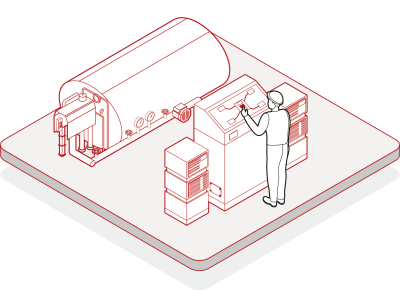
An electric heater converts electrical energy directly into heat and transfers it to a heat transfer medium. Heat transfer takes place without combustion, meaning that there are no exhaust gases, emissions or fuel residues.
Structure and process steps
- Heating elements: Electric heating rods or heating coils, essentially electric immersion heaters or resistance heaters, are heated by the flow of electricity and transfer the heat generated directly to the surrounding medium.
- Heat transfer circuit: The medium heated in a forced-flow water heater is pumped through a closed system to the connected consumers.
- Temperature control: The heating output is regulated continuously or in discrete power stages and precisely adapted to the process.
- Safety and monitoring systems: State-of-the-art, standard-compliant control and regulation technology monitors the temperature, flow and safety of the system.
Technical features of CAW electric heaters
- Almost 100% efficiency in converting electrical energy into heat – typical operating voltages are 400 to 600 V and 50 or 60 Hz, although virtually all special voltages typical for a given country are possible.
- Highly precise temperature control, especially during rapid load changes.
- No exhaust gas ducting, chimney system or fuel storage required.
- Designed for continuous operation and high thermal loads.
- Suitable for various heat transfer media such as mineral and synthetic thermal oils, warm and hot water.
Where are electric heaters used?
Electric heaters are used as a central or supplementary heat source in a wide variety of plant designs. CAW designs electric heaters as stand-alone solutions, as an integral part of existing and newly planned complex process heating systems, or as temporary heating systems during modernisation and conversion work.
Typical system types and operating environments
Thermal oil circuits
Electric heating of thermal oil for high-temperature processes.
Warm and hot water systems
Emission-free heating of closed water circuits.
Hybrid systems
Combination of electric heaters and fired systems for peak load coverage.
Decentralised process heat
Local heat supply without a central combustion plant.
Renewable energy plants
CO2-neutral use of electricity from photovoltaics, wind or hydroelectric power.
Use as a component of complex energy systems
-
In conjunction with thermal oil systems for emission-free process heat generation.
-
As a supplement to incinerators for flexible power adjustment.
-
In combination with ORC systems for the efficient use of electrical energy.
-
In plants with high requirements for emission control and licensing law.
Industries in which electric heaters are used
Electric heaters are in demand wherever clean, precise and low-maintenance process heat is required. Their flexibility makes them suitable for numerous industrial applications in the power range from 100 to approx. 10,000 kW.
Typical industries

Plastics and rubber industry

Chemical and pharmaceutical industry

Food and agricultural industry

Textile and nonwoven fabric production

Mechanical and plant engineering

Electronics and semiconductor industry

Research and development (R&D), pilot plants and test benches
Typical applications
-
Tool and mould heating
-
Extruder and reactor heating
-
Roller and calender heating
-
Temperature control of test benches and experimental facilities
-
Process heat for emission-sensitive production areas
-
Electric heating of thermal oil or water circuits