• Home
  • Tubular Heat Exchanger

    Tubular heat exchangers for industrial process heat

    safe, efficient and durable

    Tubular heat exchangers are key components in industrial energy and process heating systems. They transfer thermal energy safely and efficiently between two media without them coming into contact with each other. CAW develops and manufactures robust tubular heat exchangers for demanding industrial applications – designed for maximum heat transfer rates, high temperature and pressure stability, and long operating cycles.

    Our tubular heat exchangers are individually adapted to the medium, temperature range and process requirements and are used in both new and existing plants.
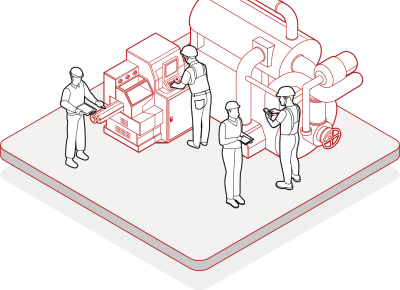
    How does a tubular heat exchanger work?

    A shell and tube heat exchanger transfers heat between two media separated by a tube wall. One medium flows through the tubes, while the other flows around the tube bundle inside the housing. Heat transfer takes place exclusively via the tube wall.

    Structure and process steps

    • Tube bundle: Tubes arranged in parallel or concentrically form the heat transfer surface.
    • Housing: This encloses the tube bundle and carries one of the two media, depending on the type and composition and based on purely thermodynamic and fluid dynamic considerations.
    • Inlet and outlet chambers: Distribute the media evenly across the tubes and reduce gas pressure losses at the same time.
    • Flow control: Optimised tube surfaces and deflections ensure consistently high heat transfer coefficients.
    • Media separation: Complete separation of the media prevents any mixing and thus contamination.

    Technical features of CAW tubular heat exchangers

    • Designed for high temperatures and low differential pressures.
    • Large heat transfer surfaces with compact design.
    • Suitable for liquid and gaseous media.
    • Versions with removable and replaceable tube bundle for easy maintenance.
    • Manufactured according to requirements and needs, also in accordance with applicable pressure equipment directives and industry standards.

    Where are tubular heat exchangers used?

    Tubular heat exchangers are used in a wide variety of plant designs wherever heat needs to be reliably transferred, recovered or distributed. CAW integrates these heat exchangers precisely into existing or new systems.

    Typical system types and operating environments

    Thermal oil plants

    Heat transfer between thermal oils and secondary media.

    Steam generators

    Condensers, preheaters or waste heat recovery systems.

    Waste heat and residual heat utilisation systems

    Recovery of process or exhaust heat.

    TRO- and incinerators

    Use of hot exhaust gases for heat generation.

    Hot water and warm water systems

    Energy distribution in closed circuits.

    Use as a component of complex energy systems

    • For generating steam, warm or hot water from thermal oil.
    • As a combustion air preheater/economiser to increase the efficiency of combustion plants.
    • In combination with ORC systems for the utilisation of waste heat.
    • For the thermal separation of safety-critical media.

    Industries in which tubular heat exchangers are used

    Tubular heat exchangers are universally applicable and are used in almost all branches of industry involving thermal processes. CAW systems are designed for harsh operating conditions while offering high availability.

    Typical industries

    Energy and power plant industry

    Chemical and petrochemical industry

    Wood and wood-based materials industry

    Paper and pulp industry

    Food and agricultural industry

    Building materials and cement industry

    General mechanical and process engineering plant construction

    Environmental and other chemical and biological process engineering

    Typical applications

    • Heating or cooling of process media
    • Waste heat recovery from production processes
    • Condensation and evaporation of media
    • Thermal decoupling of different circuits
    • Optimisation of the energy efficiency of industrial plants

    References

    Our experienced and competent staff will be happy to help you.

    Find out more about our industry solutions,
    give us a call or send us an email.

    © 2015–2026 CAW