• Home
  • Systemlösungen
  • ORC systems
  • ORC systems for decentralised power generation

    Increased efficiency through intelligent waste heat utilisation

    Numerous industrial processes generate large amounts of waste heat that remains unused, even though it offers considerable energy potential. An ORC (Organic Rankine Cycle) power plants can be used to tap into this potential and efficiently convert heat into electrical energy. CAW integrates ORC systems into existing or new plants, enabling economical and low-emission electricity generation directly on site.
    How does an ORC systems work?

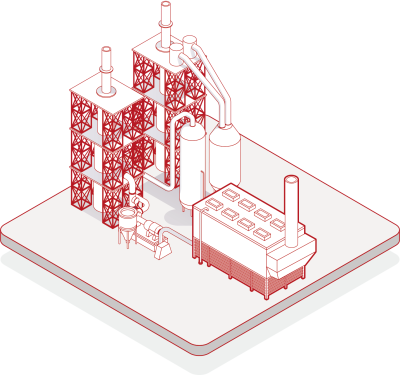
    An ORC systems uses an organic working medium that evaporates at moderate temperatures due to its low boiling point. This makes it possible to tap into heat and waste heat sources for commercial power generation, even those whose temperature levels are too low for conventional steam turbines.

    Basic principle of an ORC turbogenerator plant

    • An existing heat source, such as waste heat from combustion processes, thermal oil heaters or other hot gas streams, heats the organic working medium in the evaporator.
    • The working medium evaporates under pressure and flows into a single-stage or multi-stage axial or radial turbine.
    • Mechanical energy is generated in the turbine, which drives a three-phase generator.
    • The working medium is then liquefied in the condenser and fed back into the cycle.
    • A feed pump generates the required pressure in the working cycle.

    Technical features

    • Power generation from heat sources between approx. 80 and 350 °C, depending on the working medium and design.
    • Low mechanical stress on the turbine due to moderate speeds.
    • Closed working cycle with high operational reliability.
    • High flexibility in terms of heat sources: thermal oil, hot water, hot and exhaust gas flows.

    Advantages of an ORC system

    Efficient use of waste heat

    Generating electricity from energy that would otherwise be unused and irreversibly dissipated.

    Increase in overall efficiency

    Existing systems such as thermal oil heaters, thermal production and thermal processing plants are operated much more efficiently.

    Low operating costs

    The ORC process is fully automated and requires little maintenance.

    High system availability

    Robust and proven technology, suitable for continuous duty operation.

    Flexible integration

    Can be retrofitted into existing systems or incorporated into new systems.

    Emission reductions

    Higher heat recovery and utilisation rates reduce both fuel consumption and CO2 emissions per unit produced.

    Eligible for funding

    Many countries offer attractive subsidy programmes for waste heat utilisation and efficiency improvements.

    Industries and typical areas of application for ORC systems

    ORC systems are suitable wherever thermal energy (exergy) is continuously generated but not fully utilised. Thanks to the variety of possible heat sources, they can be used across a wide range of industries.

    Typical industries

    Biomass and waste incineration

    Wood industry and wood-based materials production

    Chemical and petrochemical industry

    Food and agricultural industry

    Plastics and rubber industry

    Oil and gas industry

    Mechanical and plant engineering

    Industrial processes involving hot air or hot gas flows

    Examples of applications

    • Power generation from exhaust gases from combustion plants.
    • Coupling with thermal oil systems to utilise excess process heat.
    • Integration into production lines with preferably high continuous loads and constant waste heat potential at the same time.
    • Electricity production from hot water or thermal oil circuits.
    • Increased efficiency of CHP plants through additional use of waste heat.

    Heat sources and media for ORC systems

    ORC systems can be adapted to different primary and secondary heat sources. The decisive factor is a sufficiently high temperature difference between the evaporator and condenser.

    Possible heat sources

    • Hot air and hot gases from industrial and heat treatment furnaces
    • Exhaust gases from incinerators and thermal processes
    • Thermal oil from high-temperature circuits
    • Hot water from stationary or mobile heating systems
    • Waste heat from production machines or drying plants.

    Working media

    • Organic fluids with low boiling points
    • Media with high thermal stability and good evaporation characteristics
    • Optimised media selection for temperature range, pressure level and turbine performance.

    Why CAW’s ORC systems are the right choice

    CAW combines ORC systems from leading global manufacturers with its own state-of-the-art industrial heating and combustion technology. Our comprehensive solutions are robust, durable and precisely tailored to your existing heat and/or waste heat sources. Whether as a retrofit or a new build, we develop systems that sustainably improve your efficiency and process economy while also generating electricity.

    We would be happy to advise you on the technical possibilities, economic potential and optimal integration of an ORC system into your processes.

    Our experienced and competent staff will be happy to help you.

    Find out more about our industry solutions,
    give us a call or send us an email.

    © 2015–2026 CAW